


Chlorine is one of the most widely used disinfectants in the world for water treatment: from purification to industrial plants, its ability to eliminate bacteria, algae and contaminants makes it an essential element in numerous processes. However, working with this compound requires care and expertise, as it is a substance that does not allow for approximation. Choosing the right dosing pump is therefore a determining factor in ensuring effective, safe and waste-free treatment.
In this article, we at Mixtron will provide a detailed overview of everything you need to know to choose and make the best use of a chlorine dosing pump.
In which sectors are chlorine dosing pumps used?
Chlorine and its derivatives, including sodium hypochlorite, are used in a wide range of industrial and civil sectors.
In drinking water treatment, dosing pumps are used to ensure continuous disinfection of water intended for human consumption, eliminating pathogens and biological contaminants. In agriculture and animal husbandry, the dosing of chlorine and sodium hypochlorite is essential for sanitising irrigation systems and drinking troughs, contributing to animal health and crop quality.
The food and beverage industry also makes extensive use of these solutions for the disinfection of surfaces, equipment and process water, where compliance with strict hygiene standards is required by law.
Further applications can be found in the wastewater treatment sector, where chlorine is used to reduce the bacterial load before discharge, and in industry for the sanitisation of hydraulic circuits and cooling towers.
Why dosage accuracy is crucial with chlorine
Precise and constant chlorine dosing is not only a matter of efficiency, but also of safety. Chlorine is a chemically aggressive substance and its concentrations in water must be kept within well-defined ranges: insufficient dosing compromises the effectiveness of disinfection, while excess dosing causes pH fluctuations that can be harmful to plants, production processes and people who come into contact with the treated water. This is particularly critical in all contexts where water quality has a direct impact on human or animal health, or on the yield of an industrial process.
A dosing pump designed to work with chlorine must therefore guarantee continuity, repeatability and reliability over time, adapting to changes in the system flow rate without ever losing injection precision.
Technical characteristics of a chlorine dosing pump
In order to operate correctly with chlorine and its derivatives, a dosing pump must meet specific technical requirements. First, the dosing range must be calibrated to the actual needs of the application: for water treatment with chlorine, the injection concentration is typically between 0.03% and 0.3%, a deliberately low value given the high aggressiveness of the compound.
The flow rates involved are generally low, with systems rarely exceeding 3 m³/h, which makes it essential for the pump to be able to operate accurately even at very low flow rates.
Another critical parameter is compatibility with the operating pressures of the system in which the pump is installed: the machine must be able to inject the dosing agent against the pressure of the main line without any loss of precision.
Finally, ease of adjustment and maintenance is an important requirement, especially in remote installations or in contexts where technical personnel are not always available.
Recommended materials and configurations for chlorine compatibility
When working with aggressive substances such as chlorine and sodium hypochlorite, the choice of materials used in the construction of the dosing pump is crucial to ensuring durability and reliability over time.
At Mixtron, based on years of experience in the chemical additive dosing sector, we recommend the use of polypropylene (PP) pumps, a material that offers excellent chemical resistance to most chlorinated compounds, ensuring structural integrity even under continuous use. However, the most important element to consider when dosing chlorine is the bypass configuration: this technical solution is strongly recommended to protect the internal parts of the motor from the aggressiveness of chlorine, preventing premature damage and significantly extending the useful life of the pump. The bypass is not an optional accessory, but a preventive measure that we at Mixtron always recommend in this type of application, regardless of the concentration of the chlorinated compound used.
The key role of Mixtron
In such a complex context, where margins for error are reduced to a minimum, Mixtron is an international benchmark for the supply of chlorine dosing pumps, with installations active all over the world, from the European market to Central America, as in the case of an application implemented in Guatemala for water treatment.
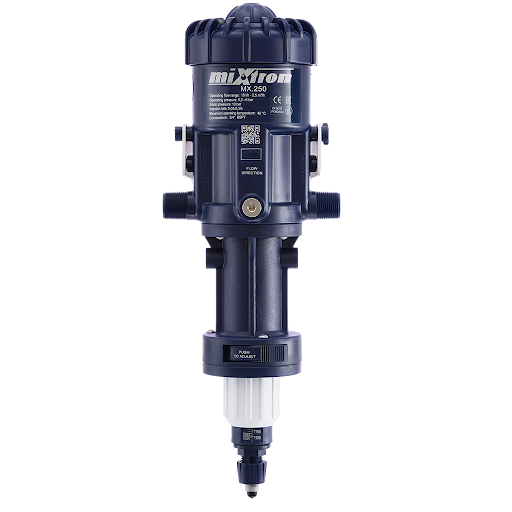
MX.250.P003 with BYPASS: the most suitable dosing pump for chlorine
Among the numerous models in our catalogue, the MX.250.P003 dosing pump with BYPASS is the solution that we at Mixtron recommend par excellence for dosing chlorine and its derivatives. A distinctive feature of this model is that it does not require a power supply: it is a proportional hydraulic pump, which makes it particularly suitable for installation in open fields, remote areas or contexts where the availability of electricity is not guaranteed.
The dosage ratio is flexible and works with a pressure between 0.3 and 6 bar, with a maximum peak of 10 bar, to adapt to a wide range of systems. Robustness is guaranteed by metal components in AISI 316 and Duplex steel, while high-quality technopolymers and the range of seals available ensure long life even in contact with chemically aggressive substances. The pump can be installed suspended on the wall or directly on the drum, offering mounting flexibility in any plant configuration. The operating temperature is between 5°C and 40°C, parameters that make it suitable for the vast majority of industrial and civil applications.
Conclusion and Mixtron contacts
In conclusion, chlorine dosing pumps are technical components that require careful and informed selection: from the chemical compatibility of materials to dosing precision, every detail affects the safety and efficiency of the entire system. Relying on a partner with international experience in the sector makes the difference between a solution that is reliable over time and a system that generates problems and unexpected costs.
To receive personalised technical advice or request information about our products, contact the Mixtron team via our contact page: our specialists are available to identify the solution that best suits your needs.
You might also be interested in





Are you ready to experience innovation?
A wide range of cutting-edge technology solutions for any application