


What a dosing pump is for in pig farming
In pig farming, the drinking water is far more than a simple requirement: it is the channel through which the essential additives for the animals' health and growth are delivered to the whole herd. For this reason, the livestock dosing pump has become a central tool in the day-to-day management of the farm.
In this sector the doser performs two main functions: mixing the additives precisely into the water the animals will drink, ensuring that every animal receives the correct dose, and supporting the disinfection of the pipework of the water system, an essential aspect for maintaining optimal hygiene conditions along the entire drinking-water line.
Which products are dosed on pig farms
The versatility of a dosing pump is best appreciated in the variety of products it can deliver through the drinking water. On pig farms the doser is used to convey:
- Vitamins and supplements, to support the growth and welfare of the animals;
- Medicines, to prevent and treat diseases and infections;
- Additives and acidifiers, useful for maintaining optimal gut health and supporting nutrient absorption;
- Disinfectants, also used for cleaning and disinfecting the pipework of the water system.
For each of these products the logic is the same: the dose must be precise and constant, so as to guarantee the effectiveness of the treatment without waste and without risks to the health of the herd.
What problems it solves and the benefits it offers
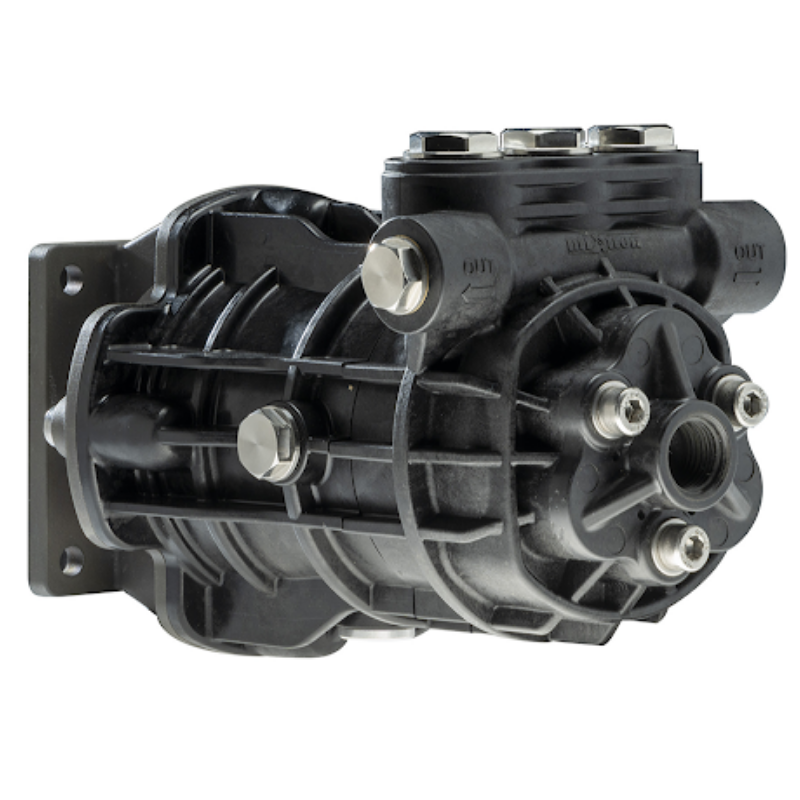
The main difficulty on a pig farm is ensuring that every animal takes in the correct amount of active ingredient, even though water consumption varies through the day and from animal to animal. This is where the volumetric proportional doser from Mixtron offers its decisive advantage: it mixes the product precisely and accurately regardless of variations in water flow. The dosing rate always stays proportional to the volume passing through the doser, ensuring that the delivery of vitamins, medicines, additives or disinfectants is constant and reliable for the whole herd.
This brings concrete benefits for the farmer: uniform delivery of treatments, which reduces the risk of under or overdosing, and the reassurance of a dosing system that requires no electrical power supply and works continuously, without constant manual intervention. Integration, finally, is extremely simple: the doser is connected directly to the pipework of the water system used for drinking, with no need for complex installation work.
The technical characteristics to consider when choosing
Choosing the right dosing pump for pig farming rests on a few precise technical parameters, linked above all to the nature of the additives used and to the size of the farm.
A contained dosing rate, within 5%
The products administered on pig farms, such as medicines, acidifiers and supplements, are generally fairly acidic and aggressive and are used at low concentrations. For this reason the most widely used models work with a contained dosing rate, within 5%: a low percentage is enough to guarantee the effectiveness of the treatment and, at the same time, to preserve the health of the animals through consistent delivery over time.
Chemical compatibility and choice of seals
Because the additives can be chemically aggressive, it is important that the doser offers adequate chemical resistance. The body of the doser is made from polypropylene (PP) and polyoxymethylene (POM), while for the more acidic additives it is advisable to fit seals in Viton or Viton Extrem, which extend its working life.
Adequate flow rate and integration on the system
The flow rate should be sized according to the number of animals and the water consumption of the farm. Integration, as noted, remains extremely simple: the doser connects to the pipework of the drinking system, with no need for an electrical power supply or complex installation work.
The Mixtron models recommended for pig farming
Among the catalogue solutions, for pig farming Mixtron indicates two models, to be chosen according to the concentration of the additive to be delivered.

Model MX.250.P022
The MX.250.P022, with a flow rate of up to 2.5 m³/h and a dosing range from 0.2 to 2%, offers the low-percentage precision ideal for delivering medicines, supplements and acidifiers, additives used in contained concentrations. It is the benchmark choice for ensuring a constant, uniform delivery to the whole herd.
Model MX.250.P150
The MX.250.P150, with a flow rate of up to 2.5 m³/h and a dosing range from 1 to 5%, shares the same flow rate as the MX.250.P022 but extends the dosing range up to 5%, making it suitable when additives or products need to be dosed at higher concentrations.

An investment in the health and productivity of the farm
In pig farming, the management of the drinking water directly affects the two factors that matter most: the welfare of the animals and the profitability of the business. Dosing that is always correct means effective treatments, more uniform herds and a drinking-water line kept in optimal hygiene conditions, with a concrete impact on the health of the entire farm.
This is where Mixtron's experience makes the difference: from the choice among the available models to sizing against the number of animals, through to the configuration of the seals according to the additives used, the company's technical support helps identify the solution best suited to each situation. To understand which doser best meets the needs of your farm.
You might also be interested in

Are you ready to experience innovation?
A wide range of cutting-edge technology solutions for any application