


What is fertigation and why the dosing pump matters
Fertigation is the agronomic practice that allows water-soluble fertilisers, correctives and crop protection products to be delivered directly through the irrigation system. An efficient, precise and increasingly widespread method, suited to small greenhouses as well as large-scale intensive cultivation, that reduces product consumption, optimises labour time and ensures a uniform distribution of nutrients along the entire water line.
The component that makes all of this possible is the proportional volumetric dosing pump: a device that injects a quantity of additive into the water proportional to the flow rate, continuously and without electrical power. Selecting the right model for your irrigation system is not a secondary consideration. It is a technical decision that affects crop yield, component longevity and ease of maintenance over the long term. This guide outlines the key selection criteria and the most suitable Mixtron solutions for each application.
Which substances are applied in fertigation
The products that flow through the irrigation system
Selecting the right fertigation dosing pump starts with a thorough understanding of the substances it will be required to handle. Not all agronomic products share the same chemical and physical characteristics: some are neutral and straightforward to manage, others are acidic or oxidising and require specific configurations. Understanding this distinction is the first step towards avoiding configuration errors that can compromise both the dosing pump and the crop.
The categories of product most commonly used in fertigation systems are the following.
Water-soluble and liquid fertilisers
They are the most widely used category. Nitrogen, phosphate and potassium compounds in aqueous solution are dosed during the periods of highest nutritional demand of the crop. Their chemical aggressiveness is generally low, but the concentration in solution varies depending on the crop, the growing medium and the vegetative stage.
Acidifiers
Products based on nitric, phosphoric or citric acid, used to bring the pH of the irrigation water to the optimal values for root nutrient uptake. They are among the substances that require the greatest attention when selecting the dosing pump's internal seals.
pH stabilisers and correctives
Buffer or alkalising solutions used to keep the pH within defined ranges, often in combination with acidifiers during the management of hydroponic or substrate-based nutrition.
Sanitisers
Products based on hydrogen peroxide or peracetic acid, used for the periodic disinfection of irrigation lines and the prevention of biofilm and dripper blockages. They are chemically among the most aggressive substances and require rigorous verification of compatibility with all the dosing pump's materials.
Vitamins, amino acids and biostimulants
Organic formulations used in the integrated management of plant nutrition. They generally present low chemical aggressiveness but may have variable viscosity, a parameter that influences the behaviour of the dosing pump at low flow rates.
Chelated microelements
Solutions containing iron, zinc, manganese, boron and other micronutrients in chelated form, administered to correct specific deficiencies identified through foliar or substrate analysis. Chemical compatibility depends on the nature of the chelating agent used in the formulation.
This variety of substances explains why the configuration of the dosing pump, and in particular the choice of internal seals, is a technical aspect that cannot be standardised: it must be defined on a case-by-case basis according to the most aggressive product the dosing pump will be required to handle over the course of its operational life.
The primary selection factor: system flow rate
Why flow rate determines the dosing pump model
When selecting a dosing pump for an irrigation system, flow rate is the essential starting parameter. The proportional volumetric dosing pump is a passive hydraulic device: it has no electric motor, but is driven solely by the water flow that passes through the system. This means it operates correctly only when the actual flow rate falls within the operational range for which it was designed.
If the flow rate is below the expected minimum, the internal mechanism does not activate correctly and dosing is absent. If the flow rate exceeds the upper limit, there is a risk of compromising the internal components and losing the proportionality of dosing, undermining the nutritional precision that fertigation requires.
What flow rate to use as a reference
The reference value is not the nominal flow rate of the system's head pump, but the actual flow rate measured under real operating conditions, that is, with all irrigation sectors working simultaneously in the most common configuration. In systems with variable-flow sectors, the sizing must be verified for both the minimum and the maximum flow rate, to ensure precise dosing under every operating condition.
The Mixtron range covers a very wide interval, from 750 l/h up to 13,000 l/h, offering a suitable solution for every type of system.
Small greenhouses and drip systems on limited surface areas
For small surface areas with drip irrigation systems operating at low flow rates, the MX075 model represents the entry-level solution, with an operational flow rate of up to 750 l/h. It is the ideal choice where daily water volumes are limited but nutritional dosing precision remains a non-negotiable requirement.
Medium-sized irrigation systems
Vineyards, orchards and open-field vegetable crops with medium-flow irrigation systems fall within the range covered by the intermediate models in the Mixtron range, up to 9,000 l/h. For this segment, the maximum dosing rate is guaranteed up to 5%, fully consistent with the fertiliser concentrations used in professional fertigation.
Large-scale irrigation systems
For crops requiring high water volumes, Mixtron offers models up to 13,000 l/h, with a dosing range also contained within 5%. These are solutions designed for intensive agricultural operations where continuity and dosing precision across large surface areas are non-negotiable requirements.
The Key technical characteristics of a fertigation dosing pump
What to evaluate beyond flow rateù
Once the reference flow rate has been defined, the selection is refined by three technical aspects that carry particular weight in the context of fertigation. These are parameters that directly influence the dosing pump's longevity, dosing precision and practicality of use over the course of the agronomic seasons.
Seal selection based on the substance being dosed
The internal seals are the component most directly exposed to the chemical nature of the substance being dosed. A configuration that is incompatible with the fertiliser or corrective being used accelerates seal deterioration, causes dosing imprecision and generates avoidable extraordinary maintenance costs that can be prevented with the correct choice at the point of purchase.
Mixtron offers its proportional volumetric dosing pumps in three seal configurations, each optimised for a specific category of substances.
- EPDM Seals: Recommended for the majority of standard water-soluble fertilisers, biostimulants and chelated microelement solutions. This is the reference configuration for conventional fertigation with low chemical aggressiveness products.
- Viton Seals: Recommended where acidifiers based on nitric, phosphoric or citric acid are used, as well as sanitisers based on hydrogen peroxide or peracetic acid. Viton offers superior chemical resistance compared to EPDM in the presence of acidic or oxidising compounds, ensuring significantly greater operational longevity.
- Extreme Version: The configuration for the most demanding applications, involving exposure to highly corrosive substances or elevated operating temperatures. It provides maximum durability in contexts where standard seals cannot offer the necessary long-term integrity.
The general rule is this: the seal type must be selected based on the most aggressive substance the dosing pump will be required to handle throughout its entire operational life, not based on the most frequent use. A dosing pump primarily used with water-soluble fertilisers but occasionally exposed to organic acidifiers must be configured with Viton seals.
The ON/OFF valve: managing seasonality without dismantling the system
Fertigation is an inherently seasonal activity. There are periods of the year when irrigation continues but the delivery of fertilisers must be suspended: during vegetative dormancy, in the weeks preceding harvest, or when the system is used exclusively for water transport.
In these cases, the optional ON/OFF valve allows the pumping of the additive product to be deactivated while letting the water flow pass normally through the dosing pump, without the need to dismantle or bypass the component from the hydraulic system. The operation is manual, requires no tools and does not interrupt irrigation.
In practical terms: at the start of the season the selector is set to ON and the dosing pump begins proportioning the additive into the water. At the end of the fertilisation season the selector is set to OFF and the water continues to flow through the system, pure, without altering the hydraulic configuration of the system. This reduces the number of interventions on the system, lowers the risk of reassembly errors and protects the dosing pump's internal components from prolonged exposure to air.
The dosing range: why 5% is the reference threshold
The proportional volumetric dosing pump injects into the water a quantity of product expressed as a percentage of the total volume. This injection ratio, the so-called dosing rate, is a critical parameter for the correct nutrition of crops and must fall within the operational limits of the installed model.
In professional fertigation, the dosing rate rarely exceeds 5%. Typical concentrations for water-soluble fertilisers range between 0.2% and 3%, while acidifiers and correctives are used at even lower concentrations. Dosing rates above 5% are virtually absent in standard agronomic applications, as high concentrations of fertiliser in the irrigation water generate osmotic stress at the roots, with phytotoxic effects on the crop.
Mixtron's medium flow rate models, from 5 m³/h to 9 m³/h, and high flow rate models, from 9.5 m³/h up to 13 m³/h, are configured with a maximum dosing range of 5%, in full alignment with the real requirements of fertigation. Dosing precision within this range is guaranteed by the proportional volumetric technology, which keeps the injection ratio constant regardless of variations in network pressure, within the operational limits of the model.
Recommended Mixtron models for fertigation
The right solution for every irrigation system
Mixtron manufactures proportional volumetric dosing pumps designed to integrate directly into the water line of the irrigation system, without the need for electrical power and without structural modifications to the existing system. Below are the most suitable models for fertigation, selected according to operational flow rate and dosing range.
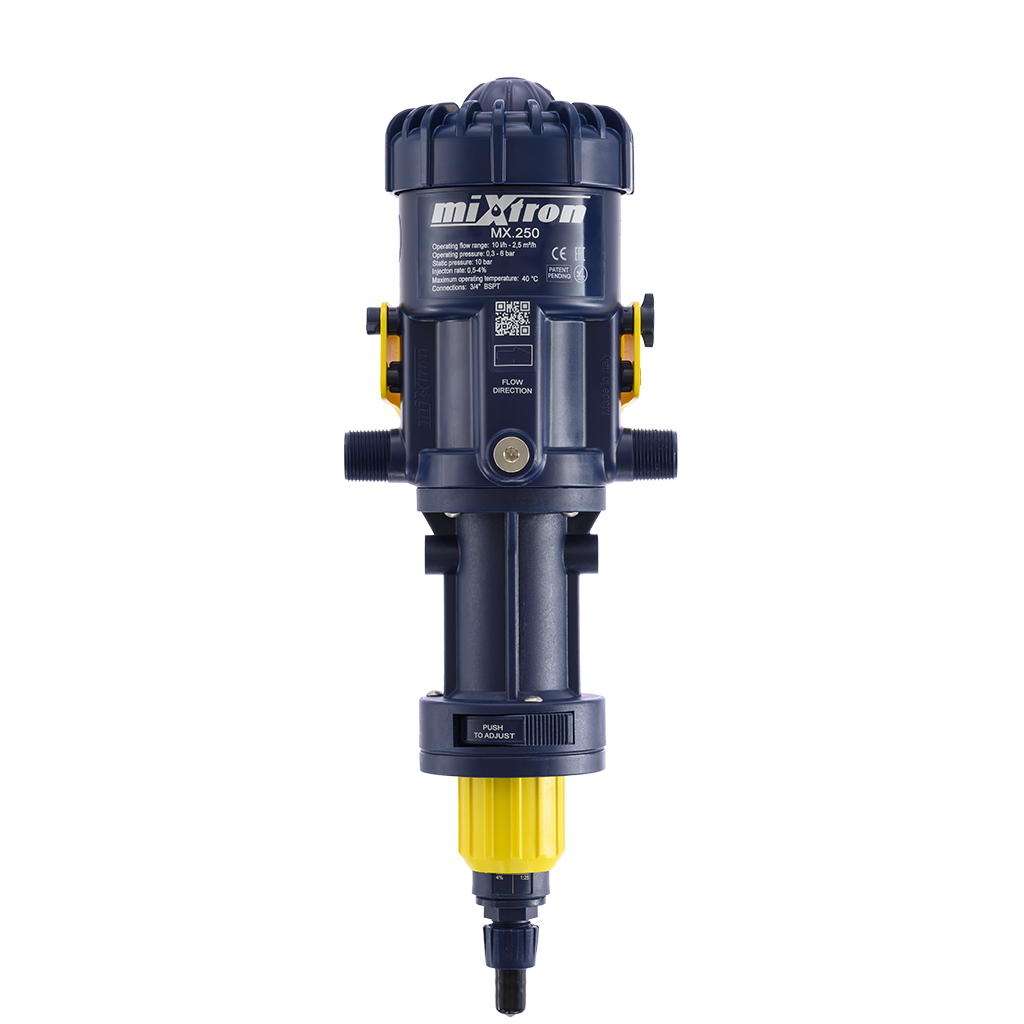
MX250P054: precision for greenhouses and low flow rate systems
The MX250P054 model is the reference solution for systems with a flow rate of up to 2.5 m³/h and a dosing range between 0.5% and 4%. Its versatility makes it particularly suited to small greenhouses, professional market gardens and all contexts where the daily water volume is limited but nutritional precision is an essential requirement. The wide dosing range makes it possible to adapt the additive concentration to crops with very different nutritional needs, without replacing the dosing pump.
MX500P022: controlled dosing for medium-sized systems
For systems with a flow rate of up to 5 m³/h, the MX500P022 model offers a dosing range between 0.2% and 2%, ideal for the delivery of fertilisers at a controlled and constant concentration across vineyards, orchards and medium-sized horticultural crops. The higher flow rate compared to the previous model makes it suited to systems serving larger areas or working with several irrigation sectors active simultaneously.
High flow rate range: up to 13 m³/h for large-scale cultivation
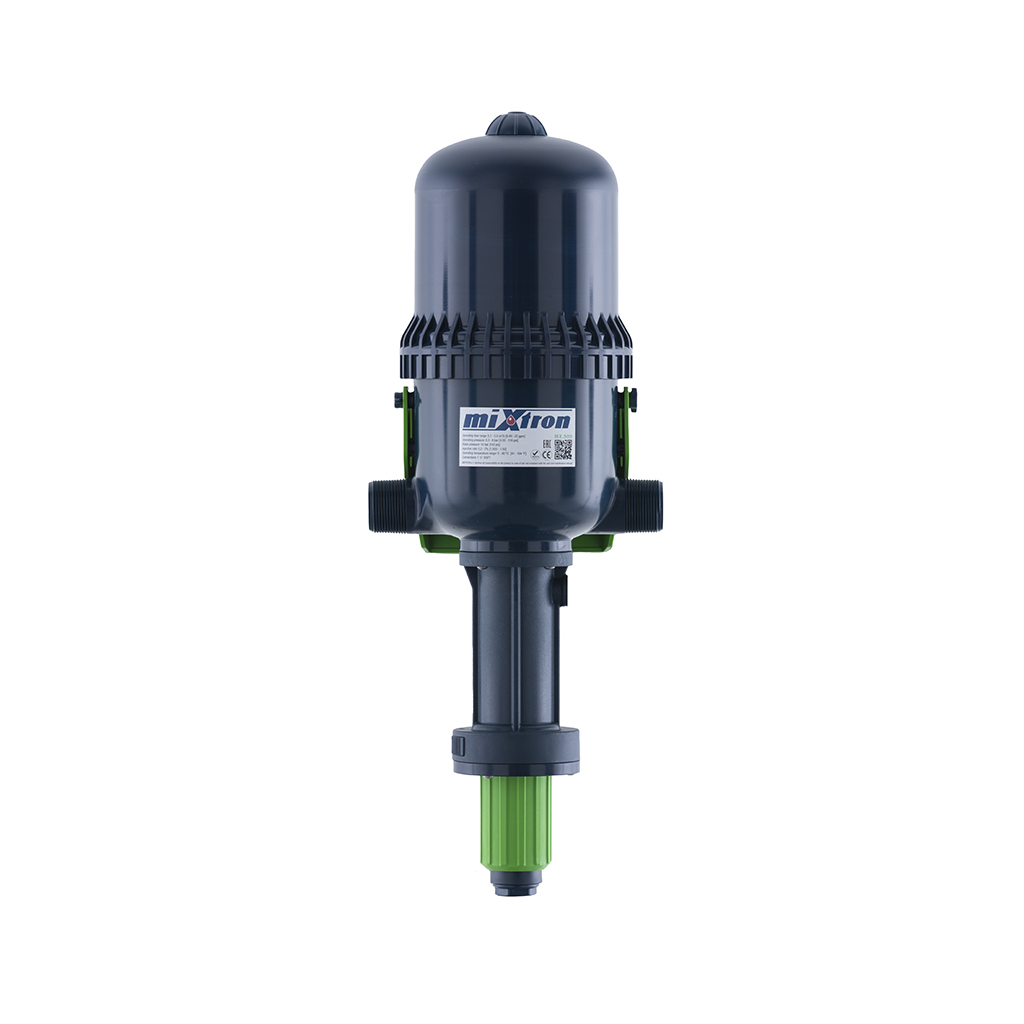
For intensive agricultural businesses with systems requiring flow rates of up to 13 m³/h, Mixtron offers specific models that can be configured according to the characteristics of the system and the product being dosed. The maximum dosing range is kept within 5%, in line with the usage concentrations of large-scale professional fertigation. To identify the most suitable model for your needs, you can use the Find a Product tool or contact the Mixtron technical team directly for a tailored consultation.
Choosing the right dosing pump is a technical decision
Choosing a fertigation dosing pump is not simply a matter of selecting the cheapest or most widespread model on the market. It is a decision that starts with the analysis of the system, goes through the knowledge of the substances to be dosed and takes shape in the correct configuration of flow rate, seals and dosing range. Every variable counts: a dosing pump undersized relative to the actual flow rate of the system, or configured with seals incompatible with the product being dosed, generates dosing imprecision, avoidable maintenance costs and, in the most serious cases, damage to the crop.
Following the criteria outlined in this guide makes it possible to approach the selection methodically, always starting from the actual flow rate of the system, verifying the chemical compatibility of the seals with the agronomic products used and evaluating optional features, such as the ON/OFF valve, according to the real seasonal operating needs. A correct configuration from the moment of installation is the premise for years of precise and reliable operation, with maintenance interventions kept to a minimum.
You might also be interested in


Are you ready to experience innovation?
A wide range of cutting-edge technology solutions for any application