


The principle behind proportional dosing
A dosing pump is a hydraulic device that injects a liquid additive into water in a way that is proportional and volumetric to the flow rate, with no electrical power supply and no need for manual adjustment when the mains pressure changes. Its working principle relies entirely on the driving force generated by the water flowing through the system: the more water flows, the more additive is dosed, keeping the injection ratio constant in every operating condition. This is what makes it a water-powered, non-electric proportional dosing pump.
Understanding how a dosing pump works is the starting point for choosing the right model, configuring it in the way best suited to the application and achieving precise, reliable dosing over time. In this article the Mixtron technical team explains the main parts that make up the volumetric proportional dosing pump, the complete operating cycle and the construction features that set Mixtron pumps apart from other solutions on the market.
The main parts of a dosing pump
The four components that make up the volumetric proportional doser
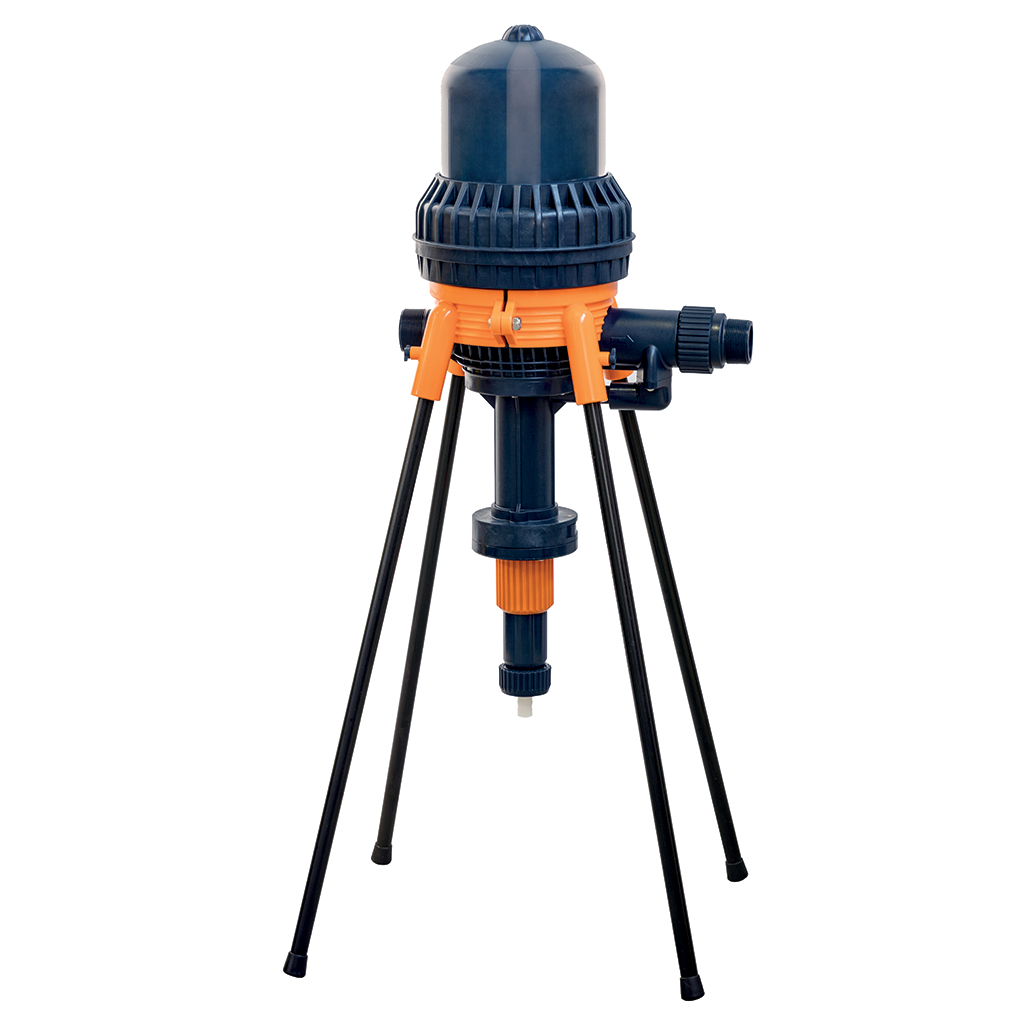
A Mixtron dosing pump is a compact hydraulic device, yet inside it integrates a series of mechanical components engineered to work in synergy. Knowing how it is structured, working from top to bottom, helps you understand its operation and identify the areas to focus on during routine maintenance.
The motor body
The motor body is the upper central part of the pump and contains the motor piston, the element that converts the pressure and flow rate of the water into reciprocating motion. It is the true "heart" of the volumetric proportional doser: it is driven solely by the water flowing through the system, with no need for an electrical power supply. The motor piston is made from specific materials chosen to withstand, both chemically and mechanically, the continuous action of the substances being handled, while the piston shaft is built from stainless steel to ensure a long working life even under intensive operating conditions.
The pump body
Below the motor body sits the pump body, which houses the dosing piston and the chamber where the additive is drawn in and then mixed with the mains water. It is in this section that the proportionality of the dosing takes place: the dosing piston, moved mechanically by the motor piston, draws the additive up from the tank and injects it into the main water flow. In models with a dosing range from 1% to 10%, the pump body integrates a dual mixing chamber, engineered to ensure a perfect emulsion between water and oil-based or hard-to-mix additives.
The dosing and additive suction system
In the lower part of the pump you will find the dosing adjustment system, where the operator sets the injection percentage by means of a graduated sleeve, and the additive suction system, made up of the suction hose, the filter and the non-return valves. In this section Mixtron has integrated an additional one-way valve inside the pump body, positioned to complement the one already fitted at the end of the suction hose. This double barrier provides extra safety against leaks and blockages, reducing the risk of contamination of the main flow and extending the service life of the internal components.
The whole structure is assembled with stainless steel screws coupled to metal inserts moulded directly into the pump body, a construction solution that ensures robustness and consistency throughout the working cycles, as well as a perfect mechanical seal over time, and that sets Mixtron dosing pumps apart from the plastic-on-plastic assemblies widely found on the market.
The working principle of Mixtron dosing pumps
Volumetric proportional dosing explained step by step
The distinctive feature of a volumetric proportional dosing pump is its ability to inject into the water an amount of additive that is constantly proportional to the flow rate, with no electrical power supply and no dynamic adjustment when the mains pressure varies. This result is achieved through an alternating mechanical cycle, governed solely by the water flowing through the doser. The Mixtron volumetric proportional doser works through two consecutive phases that repeat continuously for the entire duration of the operation, signalling every movement of the piston with a characteristic "clack" sound.
Phase 1: from bottom dead centre to top dead centre
When the water begins to flow through the pump, the motor piston is pushed upwards by the pressure of the flow. During this upward phase, all the internal valves are open under pressure: the additive in the tank is drawn up through the suction hose and rises to the pump chamber. When the piston reaches top dead centre, the reversing finger comes into contact with the inversion point located in the cover. At this stage the connecting rod aligns with the mechanism spring, and this alignment releases the internal gear, producing the first "clack" of the cycle.
Phase 2: from top dead centre to bottom dead centre
At this point the pump is full of additive. The pressure exerted on the upper part of the motor piston reverses the direction of movement and pushes the piston downwards. The dosing piston begins to lower, while the motor piston continues its stroke down to bottom dead centre, still driven by the water flow. During this downward phase, the additive drawn in during the previous phase rises from the lower chamber to the upper chamber of the pump, where it is mixed with the water and fed into the main flow towards the water system. On reaching bottom dead centre, the mechanism generates a second "clack", signalling the completion of the cycle.
The complete cycle: two "clacks" make one motor cycle
Each complete motor cycle is therefore made up of one upward phase and one downward phase, marked by two consecutive "clacks". This detail is not merely an acoustic indicator: according to the Mixtron technical manual, the number of "clacks" in a 15-second interval is one of the practical methods for estimating the actual flow rate of the system and checking that the pump is working within its nominal operating range. A number of "clacks" above the limit set for the model in use indicates an excessive flow rate, a condition that calls for the installation of a larger doser to preserve dosing accuracy and the service life of the internal components.
The average dosing accuracy guaranteed by this technology is ±5%, with an average repeatability of ±3%, figures that make the volumetric proportional dosing pump the benchmark standard for applications in which constant, reliable dosing is a non-negotiable technical requirement.
What sets Mixtron dosing pumps apart
The construction features that make the difference
There are various volumetric proportional dosing pump solutions on the market, but not all of them offer the same level of construction reliability and chemical resistance over the long term. Mixtron has developed its own dosers by introducing a series of specific technical solutions, the result of an in-house research path also documented in the company's patents section.
Below are the features that distinguish the Mixtron range from industry standards.
Technical plastics selected for chemical resistance
Mixtron dosing pumps are made from polypropylene (PP) and polyoxymethylene (POM), two technical plastics selected for their chemical resistance to most of the additives used in the company's application sectors. This choice makes it possible to handle fertilisers, acidifiers, sanitisers and biostimulants with a single basic construction configuration, leaving it to the internal seals to adapt to the specific chemical characteristics of the product being dosed.
Stainless steel piston shaft
The piston shaft, a component subjected to continuous mechanical stress throughout the entire operating cycle, is made from stainless steel. This construction solution ensures corrosion resistance even in the presence of chemically aggressive substances and significantly extends the service life of the doser compared with solutions that use a shaft made from non-metallic materials.
Double one-way valve for maximum safety
Mixtron has integrated an additional one-way valve in the lower part of the doser, positioned to complement the non-return valve already fitted at the end of the suction hose. This double barrier provides extra safety against leaks and blockages, reducing the risk of the additive flowing back towards the water mains and protecting the internal components from accidental contamination. It is a feature particularly valued in all applications where the separation between the main fluid and the additive must be guaranteed with absolute reliability.
Stainless steel screws and integrated metal inserts
The entire structure of the doser is assembled with stainless steel screws coupled to metal inserts moulded directly into the pump body. This construction solution, an alternative to the more common plastic-on-plastic assembly, ensures a perfect mechanical seal over time, even after repeated dismantling cycles for maintenance, and contributes to the overall robustness of the doser under intensive operating conditions.
Dual mixing chamber for perfect emulsions
In models with a dosing range from 1% to 10%, Mixtron has designed a dosing body with a dual mixing chamber, a specific solution for the injection of oil-based additives or products that are difficult to mix with water. The dual chamber ensures a homogeneous emulsion between water and additive while still inside the doser, eliminating the risk of phase separation downstream of the injection point and improving the quality of the end product delivered through the system.
A mature technology serving operational precision
The operation of a volumetric proportional dosing pump is the result of a refined mechanical balance, in which every component, from the top cover to the suction system, helps to guarantee constant, reliable dosing for years of continuous use. It is a mature technology, perfected over time, that continues to set the benchmark standard in every sector where dosing precision is a non-negotiable requirement, from professional agriculture to water treatment, from livestock farming to industry.
Knowing the working principle of the doser, the parts that make it up and the elements that determine its build quality is the starting point for choosing the right model, configuring it in the way best suited to your application and managing it over time with targeted, effective maintenance. Mixtron solutions, designed and manufactured entirely in Italy, are the fruit of continuous technical research that has led to the integration of specific construction solutions, from technical plastics to the double one-way valve and the air-bleed button, designed to guarantee operational reliability even in the most demanding working conditions.
You might also be interested in





Are you ready to experience innovation?
A wide range of cutting-edge technology solutions for any application